The same wave hit three power stations on the same afternoon. Only one of them had a disaster.
11 March 2011: A magnitude 9 earthquake sent a tsunami onto a stretch of coast with three nuclear stations on it. At the first, three reactors melted down. Just down the coast, at a sister plant run by the same company, cooling was lost on three of four reactors - and the crew fought it back from the edge, partly by hauling cable by hand.
Further up the coast the third plant shut down as designed - and then opened its doors to neighbours who had lost their homes!
Same afternoon, same coast and in two cases even the same company - yet the endings could hardly have been more different!
The wave wasn't identical at each site - I'd be careful of anyone who says it was. But at every one of them, the people on shift did the best they could with the plant they had. That's the part I'd ask you to hold onto.
So what was the difference?
Where mistakes can kill
I've spent years working with, around and on new technology in places where mistakes can kill. Aviation, Oil & Gas, Chemicals, Power and other critical heavy industry. The technology now often includes robots, drones, sensors, artificial intelligence and the control systems that run the plant - and much of it is new to the organisations taking it on. Not an upgrade to something they already do, but something they have never done before.
In most industries a system that half-works is an inconvenience. Here it can be a hazard in its own right. A sensor that is trusted but wrong is often worse than no sensor at all.
My hunch, after twenty-five years of this, is that although the technology is usually ready, it's the operation around it that often isn't. In last year's SPRINT Robotics World Conference I heard variations of the following statement more times than I cared to count: "Technology readiness is not the constraint... Organisational readiness is". How companies adapt to novelty, govern transformation and align culture has become the real frontier.
Three elements, one apex
I'm a visual guy, so rather than write another list of principles, I thought a picture might help.
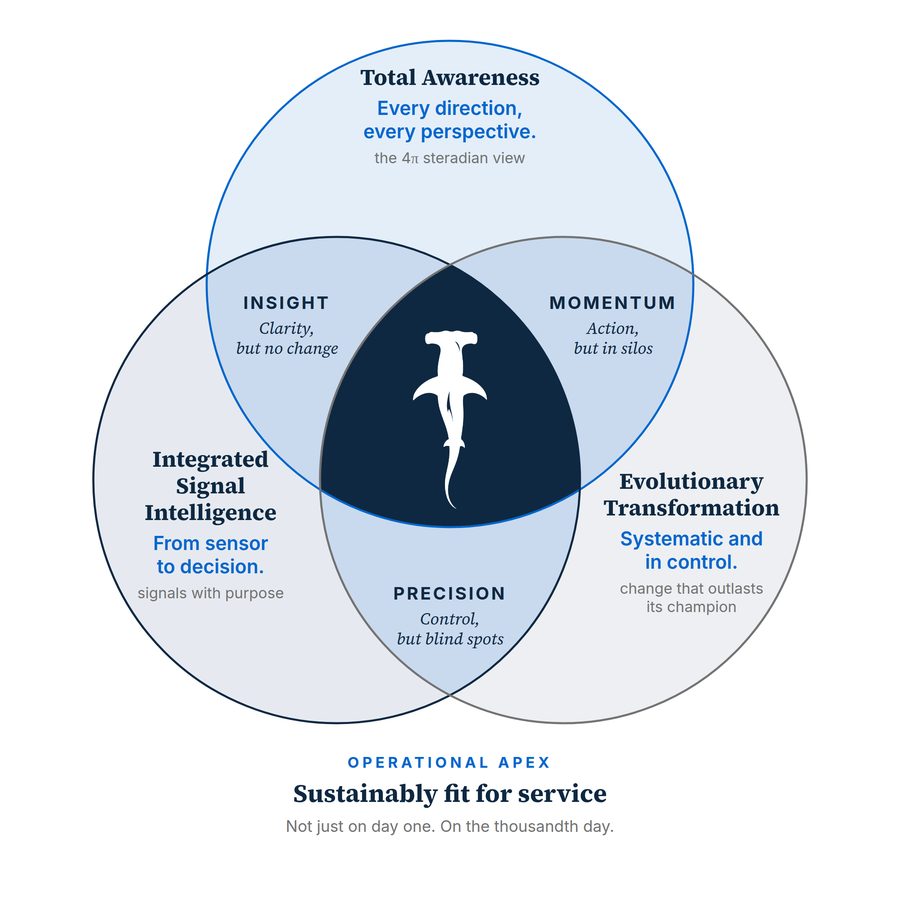
For context, the problems we're talking about here occur when any critical heavy industry tries to embed new technology in an arena where safety is maintained through stability and limiting variation or change. Even where the business case for adopting new technology earns its place, mistakes can kill. This is why I've found it useful to consider how an operator's vision for a safely deployed system needs to be viewed from three perspectives:
Total Awareness - every direction, every perspective: It's not just about the widget or the app - and it may sounds obvious, but it's so important to consider the whole system being impacted, in every direction, including up and down (the technical name is the 4π steradian view). The equipment, the people, the process and the history - including the history nobody wants to believe. Often, for completely understandable reasons, the focus for deployment will be on the elements the project team can control. However, without considering what may currently be beyond their remit, the chances of missing a critical element needed to secure a safe, sustainable, successful deployment are often much higher than anyone ever anticipated.
Integrated Signal Intelligence - from sensor to decision: Is your new system fitted with the right sensors, giving the right signals? How are those signals joined up to the whole, end to end, from the sensor on the plant to the person making the decision? Can this new information be judged well within the context of the operational entirety? Has it been set up safely and securely, and is that system really manageable long term? Often, the warning that matters is spread across several segmented, and separately managed places, leading to none of the individual signals reaching the threshold for an alarm to be triggered.
Evolutionary Transformation - being systematic and in control: Acting on what you know in a way that lasts, so it shouldn't matter who is at the controls and the change outlasts the person who championed it. The name is deliberate - transformational in what it changes, evolutionary in how it gets there - and being systematic and in control is how you get there.
Two out of three
Here is the part that matters and it's where I'd ask you to be honest with yourself - not because anyone has done a bad job... Quite the opposite.
Every overlap in the Venn is a real achievement and plenty of operations never get there. Although each one feels like success from the inside this is exactly what makes it so dangerous.
Insight is Total Awareness plus Integrated Signal Intelligence. Clarity, but no change. The risk is known, the report is good, yet nothing turns it into action.
Momentum is Total Awareness plus Evolutionary Transformation. Action, but in silos. Every team is disciplined and confident within their own patch but nobody joins the signals up... so the decision goes to whichever signal is loudest. Usually that's the deadline or the production target. (I've been the person holding the deadline... It's a very persuasive signal!)
Precision is Integrated Signal Intelligence plus Evolutionary Transformation. Control based on signals you know about, but with blind spots due to a lack of Total Awareness. Well run, systematic, judged well... but only within everything it can see. This is the most dangerous of the three, because it's the one that feels safest. Nobody was looking there, so nothing ever arrived as a signal before it was too late.
Two out of three always feels like enough - right up until it isn't. That's how good operations get caught out.
One apex
Where all three meet is the only place that stands up over time. That's the Operational Apex - and I'd argue it's the only time when things are sustainably fit for service. Not just on day one, but on the thousandth day and beyond.
Fit for purpose is a specification question - does it do what it says on the tin? A vendor answers that, in a lab, with a certificate. Fit for service is a risk question - does it work on a live asset, in real conditions, for as long as the asset needs it? Only the operator can answer that and only with a risk case they are prepared to stand behind. "Sustainably" is the word that says: still true when nobody is watching any more.
What's coming
Ever since I was an apprentice aircraft engineer many years ago, I've always found the easiest lessons to learn were the ones that came with a story. This article is the map. The next five walk the territory, one story at a time - and wherever I can, the stories come in pairs. Same catalyst, different ending.
Total Awareness: a gas plant whose engineers were more than two hundred kilometres away - and a regulator that asked the question first.
Integrated Signal Intelligence: a radar that saw them coming - twice, a year apart, with two very different endings.
Evolutionary Transformation: a ferry that sailed with its bow doors open and what my years as a licenced aircraft engineer taught me about never letting a whole asset depend on one man being awake.
The three overlaps, told from the inside.
Then the centre - The Operational Apex - and back to that coast in 2011 and the man who believed the old stories.
I'm excited to share this perspective with you and I'm hopeful you'll find it useful and worth the time to read and consider - whether you're a gnarled old operations dog who's (nearly!) too long in the tooth, or fresh faced and keen to learn the ropes!
Over to you
My hope is that these stories will help keep the lesson alive in your memories long after you close the app!
This is my own framework, drawn from a career spent on both sides of the operator–vendor table. It isn't a standard - and I'm always happy to be challenged or proven wrong on any part of it - that's what achieving the operational apex is all about anyway, isn't it?
So until next time, I'd like your perspective on two things:
Which of the three does your organisation find hardest?
Which overlap have you seen from the inside?
This article first appeared on LinkedIn, where the conversation carries on: join it there.