The radar saw the attack coming more than 130 miles out. The warning went to one officer, in an almost empty room - and the bombs still fell.
Sunday 7 December 1941, two minutes past seven in the morning: On a hill at the northern tip of Oahu, two young privates were still sitting at their radar set because the truck to take them to breakfast hadn't turned up. Their shift had ended at seven. They kept the set running for practice.
Then the biggest blip either of them had ever seen appeared on the screen.
They checked the equipment. It was working, so they phoned it in.
Where we are
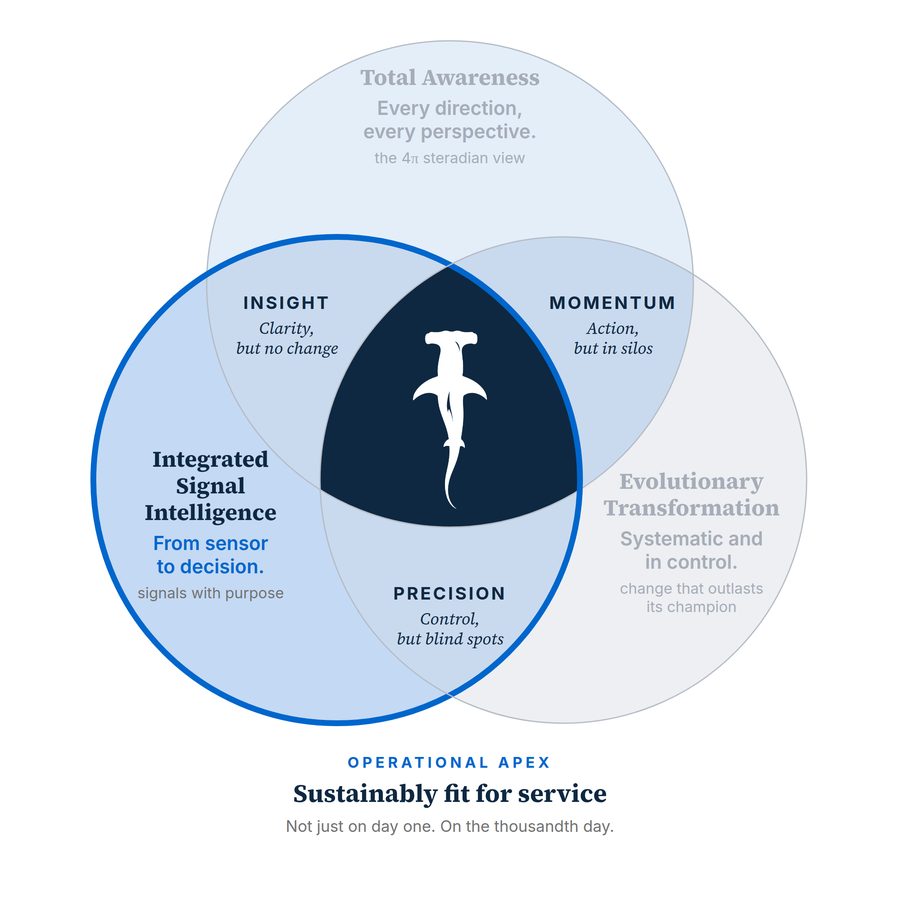
Last time was about looking in every direction: a gas plant where two hundred years of experience stood around a frozen heat exchanger yet nobody standing round it knew what the cold was doing to the steel. This one is about the step after that, because seeing something isn't the same as understanding it. Now let's take a look at the second element: Integrated Signal Intelligence - from the sensor to the decision.
From sensor to decision
Integrated Signal Intelligence - from sensor to decision. The idea in a nutshell? Signals with purpose. The right sensors give the right signals, joined end to end, from the plant to the person deciding, where they become intelligence. A signal that can't get through that chain is no signal at all.
A working operation throws off signals all day. Instrument readings; inspection results; near-miss reports; the shift handover; the operator who says a pump doesn't sound right. On their own, most of them aren't alarming. The warning that matters is usually spread across several of them, sitting in different systems with different teams, so nobody sees the whole story until afterwards. Integrated is the word doing the work. An organisation that keeps its signals in separate boxes will keep being surprised by things it technically knew.
Intelligence means contextual judgement: not just analysis, but knowing which signals carry weight and which are noise.
Although it's tempting to think the answer is to connect everything, I'd caution on that. A modern control room can, in theory, put thousands of readings and alarms an hour in front of the person on shift. But if they can't tell the few that matter from the many that don't, more connection means more noise... and noise hides a warning as surely as a missing sensor does. The humans in the loop are part of the system and who sees which signal, in what form, at what moment is a design decision.
Fit for purpose, fit for service
This is also where my own technical discipline trips over itself most often (and I've done my share of the tripping!). The radar set on that hill was fit for purpose: it did exactly what its specification said it would. Whether Oahu's air defence was fit for service on a quiet Sunday morning was a different question - and that was the question that hadn't been asked.
A vendor answers the first question with a certificate. Only the operator can answer the second, using a risk assessment built for that asset, those conditions and that shift pattern. Part of this element is the discipline of never mistaking one for the other. A certificate is one input to that decision, never the decision itself.
Same radar, two endings
Everyone in this story was doing the best they could with what they had. Two privates stayed on past the end of their shift to practise on a set that had only been with them for a couple of weeks. A switchboard operator asked whether something ought to be done - and a lieutenant on his second shift, with a brief orientation and no real training, gave the answer the expected bombers pointed to.
Where it went wrong. The call from Opana Point reached the information centre at Fort Shafter. The plotters had worked the same four-to-seven shift as the radar crew, so they'd gone. The switchboard operator found the one officer still in the building: a fighter pilot on his second shift, posted there mainly for training, with no controller and no staff.
He had a reasonable explanation. A flight of American bombers was due in from California that morning and the blip sat on almost exactly that bearing. He told the radar crew not to worry about it. The bombs started falling just before eight.
The signal was received, recognised as strange and reported by the right route. It then stopped dead, because the room it reached wasn't joined to fighters, to the Navy, or even to its own plotters. The chain ran from a working sensor to a room - and the room went nowhere. Swap him for any other untrained officer on his second shift and I believe the morning goes the same way. When the Navy's board cleared him the following year, it found he had been left with little or no training, no supervision and nobody to work with.
Where it went right. In the summer of 1940, Britain's radar was no better than anyone else's. Every radar report went to one filter room, where people decided what was one raid and what was two, what was friend and what was foe, then gave each track a number. Only then did the plot go out - down the chain, onto a table where plotters pushed markers with long rakes. In front of that table sat a controller who had the authority to send fighters up and had drilled for exactly that moment. The tables were staffed day and night. This version didn't require luck to have the right person in the room.
To be fair to Hawaii, Britain had been at war for ten months by then and was expecting raids every day. The British system wasn't born good either. In its first week at war, a radar fault showed the Royal Air Force's own aircraft as an incoming raid; the fighters sent up to meet it appeared on the plot as more raiders; RAF Spitfires shot down two of their own Hurricanes over Essex - one pilot was killed. The court martial cleared the two Spitfire pilots and called it an unfortunate accident. As I see it, everyone had done what the system told them to do. So it was the system that changed. By the following summer the RAF had greatly improved how it sorted and identified what its radar showed - and it had ways of tracking its own fighters from the ground.
What made the difference. Same technology, on both sides of the world. The radar did its job at Opana Point and it did its job on the English coast. Only one side had built the whole chain, from the set on the hill to the person who could send fighters up - and fixed that chain when it broke. That's this whole series in one story.
Three mistakes I keep seeing
The first is to be tricked into thinking that a dashboard is intelligence (I've built a few of those myself!). A dashboard simply puts signals side by side; integration means someone, or something, has actually connected them and drawn a conclusion that will stand up on Monday morning. The second mistake is assuming that connecting more signals always helps. Past a certain point it only helps if the person receiving them has a way to tell signal from noise. The third is treating a certificate as the end of a question rather than the start of one.
Three questions for your operation
Where does each signal about this change end up - and does anyone see them all together?
On a bad night, how many alarms would the person on shift face - and how would they know which one mattered?
If the most senior person in the room disagreed with the evidence, which would win?
Over to you
Next time we reach the third element, Evolutionary Transformation - being systematic and in control, so the change outlasts whoever championed it. Understanding a warning still isn't the same as staying in control of what happens next. The story? A ferry, its bow doors and the man whose job it was to shut them.
From my perspective, a warning lost in the noise is far more common than a warning that was never there. Whether you run the control room or you're the one who picks up the phone at seven on a Sunday, I'd love your perspective on one thing:
What's the most important warning you've seen get lost in the noise?
This article first appeared on LinkedIn, where the conversation carries on: join it there.