The tsunami flattened the town. The nuclear power station nearby shut down safely, then opened its gates to more than 300 people who no longer had homes.
11 March 2011: Onagawa sat nearer the epicentre than any other nuclear station. The town lost more than 800 people and most of its buildings. The wave that reached the plant was about 13 metres high.
All three reactors shut down as designed. Then, for about three months, people who had lost everything lived inside a nuclear power station.
Nobody at Onagawa had to be a hero that day. The plant came through because of an argument won in a committee room more than forty years earlier, by a man who had died in 1986.
Where we've been
This is the last of six. In this series we've discussed how three elements, when considered in the context of new technology deployment in industry, can be the difference between global headlines, or no headline at all.
Since then: a gas plant whose engineers had been moved 215 kilometres away; a radar that saw them coming; a ferry that sailed with its bow doors open; and the three places where two out of three feels like success... until it doesn't.
This one is about the centre, where all three meet. I call it the Operational Apex.
Sustainably fit for service
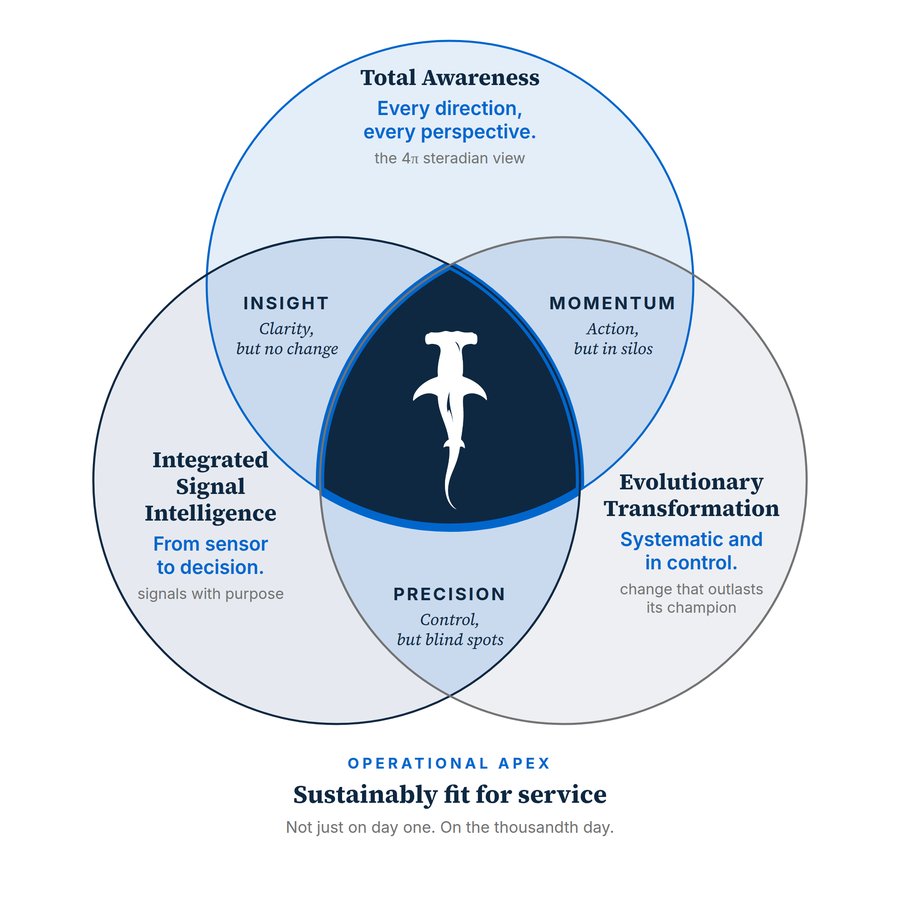
Operational Apex - all three elements working together. The target here is when a plant is sustainably fit for service - and each element here must earn its place.
It's easy to think the job is done when a system is fit for purpose. This is where most technology stops. It does what the specification says and a certificate from the vendor proves it.
Fit for service is the harder standard. Does it work on a live asset, in real conditions, for as long as the asset needs it? Only the operator can answer that, with a risk case they're prepared to stand behind. For technology that's new to an organisation, the gap between those two isn't a step. It's a very long way.
Sustainably closes the last gap. Not fit on the day of handover, but fit on the thousandth day... when the champion has moved on and nobody is watching the pilot any more.
This is the result when all three elements have come together - the apex: you've looked in every direction and from every perspective; the signals get all the way from the sensor to the person deciding; you act on them in a way that's systematic, stays in control and outlasts whoever championed it.
One plant, all three elements
Yanosuke Hirai had been a vice president of Tohoku Electric. In the late 1960s he sat on the committee planning the Onagawa plant. The early estimate for a tsunami at the site was about 3 metres.
Total Awareness - every direction, every perspective. Hirai wouldn't accept it. He had looked back through folk lore, old documents and surveys of past tsunamis on that coast: the Jogan tsunami of 869, the Keicho tsunami of 1611. He argued for a site level of about 14.8 metres, almost five times the estimate. Colleagues thought 12 would do - already four times the estimate. Every direction includes backwards; every perspective in this case included a look at the folk tales.
Integrated Signal Intelligence - from sensor to decision. His view didn't stay one man's opinion. Although I'm sure it took some persuading, Tohoku Electric set up an expert committee to bring the folklore, the records and the surveys into one body of evidence, then went out and surveyed the traces of the Jogan tsunami itself. When newer methods raised the estimate, the plant was checked again against it. The old records were the sensors; the committee was the chain that carried what they said all the way to a decision.
In keeping this story honest, it did, in part, steer closer to a hero moment than a system. As a respected former VP, Hirai had the means and opportunity to take his case to the top of the company, which backed it. This was the trigger for the shift in how things had been done before and what led to the decision being built into the plant itself, at a height that didn't depend on anyone remembering the argument.
Evolutionary Transformation - being systematic and in control. What makes Onagawa the Operational Apex is what came after: The culture changed. Re-checks and drills took place for decades after Hirai died and on the day it was the routine training that mattered. The company made his concern part of how it worked and kept challenging assumptions and testing them against new evidence. Even then it was close: the ground dropped in the earthquake and by most accounts the wave came within about a metre of the main site level. Twelve metres would have lost.
Further down the same coast, the company running Fukushima Daiichi had done the work too: in 2008 its own study predicted a possible tsunami higher than anything the plant was built for. Headquarters sent the number away for more study. Same wave, same country, same industry. The difference was the system around the warning.
Why a hammerhead
If you've wondered about the hammerhead - I'm afraid the choice was entirely personal.
I grew up around them as a kid on Sydney's beaches, with the occasional "interesting" close encounter(!). They're a beautiful creature: an apex predator without the ego you'd associate with a great white, yet one that still commands respect and carries itself with a graceful dignity. That, to me, is what heavy industry should look like where a mistake can kill.
The rest you can draw for yourself. Wide-set eyes that see in every direction, thousands of tiny sensors across that incredible cephalofoil head and a lineage that has lasted tens of millions of years by changing carefully and never losing its foundations.
Why this matters now
Back to where I started. Heavy industry keeps itself safe through stability, by limiting variation and change. New technology is change. So it has to earn its place: solve a real problem; make an honest value case; work reliably on a real asset rather than in a demonstration. Then it has to be carried the way Onagawa carried Hirai's argument, in steps that can be tested, with the foundations protected. Transformational in what it changes. Evolutionary in how it gets there.
If any of it rang true
That's the series. Thank you for staying with it - six articles is a lot to ask of anyone with a plant to run.
I'd love to hear your version - the robot pilot that never grew beyond a pilot, the control that quietly depends on one person being on shift, the warning still sitting in a report somewhere. The ones you got out of interest me as much as the ones you didn't.
Dewhurst.tech is what I do now. As an independent, I help operators take on new technology - from inspection, maintenance and surveillance robotics to the operational technology (OT) beneath them. The aim is the same every time: that it earns its place and stays fit for service long after the pilot is over. Whether you sign off the risk case or you're the one who'll be on shift when the new kit arrives, the door is open.
Over to you
So, for the last time in this series, I'd love your perspective on one thing, in the comments or by message:
If you had to pick the one element your operation is weakest in:
- looking in every direction,
- getting the signals from sensor to decision,
- or changing in a way that's systematic and in control
which would it be?
This article first appeared on LinkedIn, where the conversation carries on: join it there.